Harness the power of your voice
Harness the power of your voice

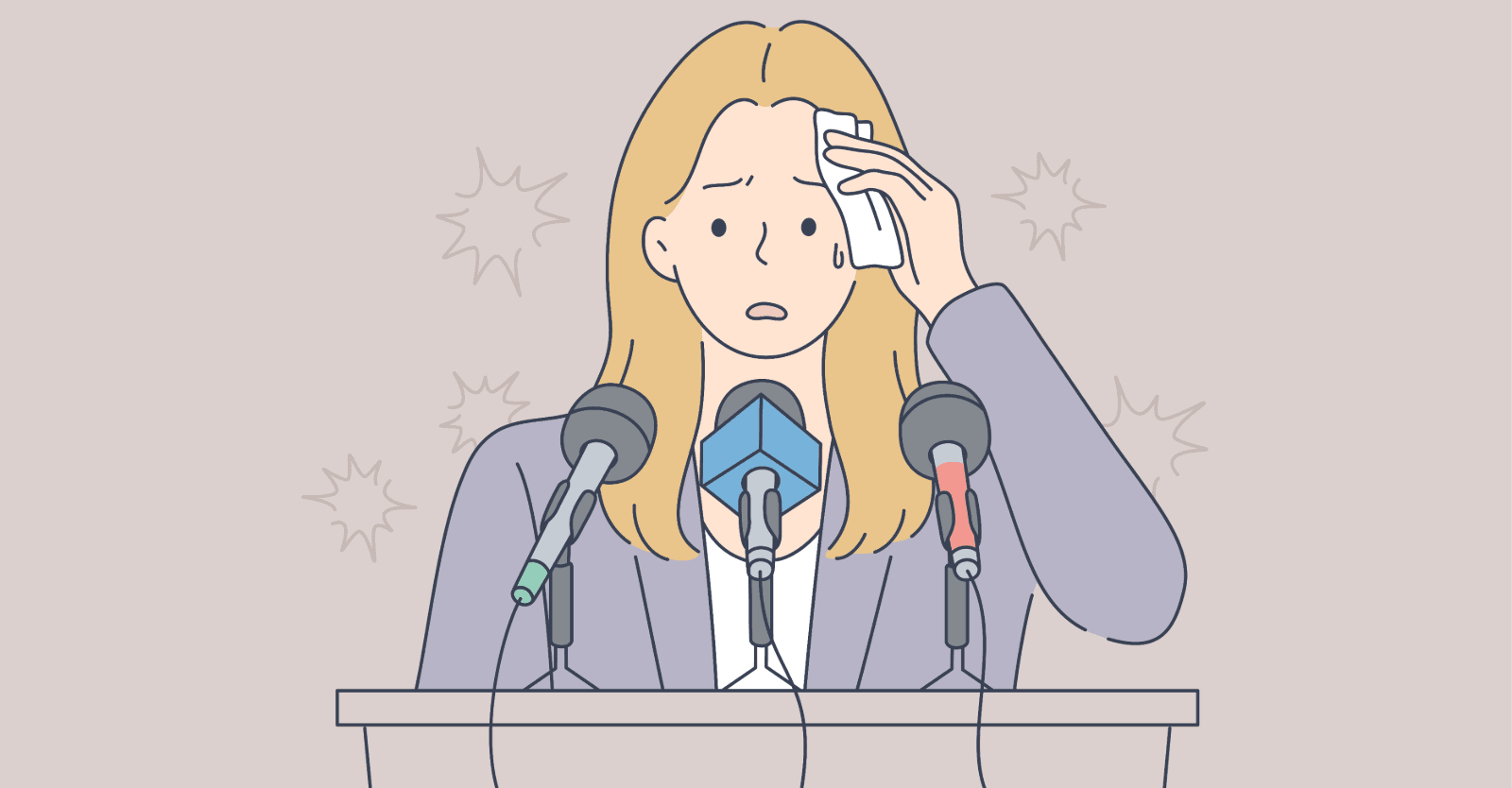
What really causes your public speaking anxiety, fear and stage fright?
In this article, we’ll explore the scenarios in which we are most likely to be caught up and taken hostage by stage fright and what you should do to be a calm, cool and collected speaker.
We experience public speaking anxiety when:
Let’s dive deeper into each. We experience anxiety and fear on the public speaking stage when:
Anxiety grows when we have something to hide but are in a situation where we feel like people can see through us. We have all gone through things that we may not be very proud of that we would prefer no one finds out. From the temptations we have struggled with or are struggling with to the sins we have committed in secret. These things evoke shame, guilt, and fear of being found out. They could result from our own actions or the actions of others, like sexual abuse. Because we feel shame or guilt, we say, “No one can know”. They are tightly kept secrets. But that is exactly the source of fear that will blow up the moment you step on a public speaking stage. Why? Because we feel transparent when people fixate their focus on us as if they can see through us.
The solution? Open up to at least one person in your life who cares about you. No matter how shameful or bad, when at least one person knows about it, you feel more relaxed and free.
Anxiety thrives when our minds are fixated on past mistakes or negative future possibilities. Don’t shift focus to imagined negative outcomes—the possibility of failing, of forgetting lines, or being criticised. Likewise, don’t start guessing what is going on in the minds of the audience (they don’t like me, they aren’t understanding…). Even when you make a mistake (which, by the way, most often is only known to you), just move on. Every time you speak, focus only on the present moment, on what you are saying now. Things in the present are manageable. But what already happened and what might happen are not in your control. Imagined negative outcomes are like fear wildfire. No one can control it.
Anxiety is fueled when we view each speaking opportunity as a defining moment, as if one misstep will forever define us. The truth is, no single mistake, failure, or success defines us, not in life nor in speaking. Each moment on stage is a piece of a much larger work. No one mistake holds this much power in your life except you offer the mistake such power and sacrifice yourself on its altar. If you fear failing in public so much, know that everyone you see excel at something in public has a story of serious failures in their past. They didn’t let their mistakes define them. They used the mistakes and failures to get better. So go out and fail. Find safe spaces in which to start failing before life forces you to fail on the big stages with bigger repercussions.
Questioning whether our message holds real value is another source of stage fright. We get nervous when we doubt that our message truly makes a difference, leading us to believe our voice is insignificant compared to that of some people in our audience, who may be more knowledgeable or polished. This self-doubt convinces us that we’re somehow inadequate, that what we need to say more than we are saying, do more than we are doing.
Here’s the reality: your story, your insights, your voice—they matter. Did you take the time to consider what’s meaningful, to craft your best message that’s true to you? Trust that what you’ve prepared has value because it does. Then speak like what you’re saying matters, and it will resonate. Believe in the worth of your message, and let that belief be the energy that connects you with your audience.
Stage fright gets aggravated when our attention is fixated on self—on how we look, how we sound, and on being brilliant. This self-centred focus disconnects us from the true purpose of speaking: conveying a message, not perfection in delivery. It’s not about you. It’s never about you. It will never be about you. What a blessing to know that it’s not about you because you aren’t that impressive, right? You are not perfect, you don’t know enough. Why put yourself under pressure to appear perfect and brilliant? Focus on the message and who the message is meant for. The hero is the audience, not you.
To excel as a speaker or writer, you must change your focus from yourself to others. Focus on what they need and on giving them what they need. Doing so will also change the way you think about your performance. Instead of thinking “I wasn’t good enough, I’m a failure, or I’m amazing.” You will think in terms of the message: “that message was not good enough for my audience, that failed, that was amazing.” Changing “the message” is much easier than changing “I, me”.
Public speaking brings anxiety when we attempt to control every aspect of the experience—the audience’s reactions, the environment, or how every point lands. Take public speaking as an exercise with unpredictable reactions and outcomes. Don’t assume people will react like this or like that. Just observe and let them surprise you. Do not try to do this or that so that they will react like this or like that. Control is an illusion. You can’t elicit your desired reactions from the audience. What you should do is curiously observe. Observe what works or resonates, what made people laugh and note it afterwards, but never assume anything to be a formula you take everywhere.
We suffer stage fright when we haven’t fully embraced the expertise and authority we possess in our subject matter. Instead of standing firm in the depth of our knowledge and experience, we question our worthiness to speak, believing someone else is more qualified or deserving. Let me ask you, did you merit the job that puts you in places where you speak? Did you research the subject you are speaking on? Yes? Then you are the right person and the authority to speak on that subject. No? What makes you think so?
You should probably have a conversation with the people trusting you with those responsibilities to know what they might be seeing in you that you are missing. Self-doubt is fertile ground for anxiety. Let your self-doubt cause you to prepare more than anyone else. Your preparation qualifies you as the subject matter expert, so step on the stage like one.
Anxiety deepens when we stray from authenticity. When we try to live up to external expectations rather than embracing who we truly are, the inner conflict creates a sense of unease. Instead of suffering yourself to be like X, learn let your authentic self be seen and heard. Study yourself because you don’t know yourself very well. Authenticity is the holy grail of success in public speaking. The public cannot and will not embrace someone who rejects themselves. The moment you start trying to say it like X or to act like Z, you have already rejected yourself and given away the right to be accepted by the audience. Even if people accept the character you present, you will feel like a fraud because you know that wasn’t you.
Anxiety escalates when our primary goal becomes impressing others rather than authentically sharing our message. In the attempt to win approval, we place our worth in the hands of others, gauging our success by how much they appear to like or validate us. This mindset is a double-edged sword: not only does it add the weight of external expectations, but it also distances us from our true purpose on stage and our true message. We start scanning the room for signs of approval, reading into every expression, and adjusting our words to fit what we assume others want.
The truth is, people are drawn to authenticity, not perfection. When we let go of the need to impress and focus instead on giving—giving our ideas, our insights, our stories—we step into a flow where anxiety loses its grip. Speakers are not performers chasing applause; we’re real people with real messages that resonate, regardless of approval.
At the root of many anxieties is the fear of negative judgment, embarrassment and reputation damage. Our biggest need when we open up and feel vulnerable is to be accepted. But always remember that the only difference between you and the person judging is that you have stepped up to be seen. Something they secretly wish they could do. Those who judge negatively are often the ones who haven’t embraced their own weaknesses. The people who reject your authentic self are not your tribe. Keep being yourself, and soon you’ll find your tribe. There’s a room you’ll enter and not only be approved, but celebrated; people will say, “Where have you been all my life?”
Anxiety often arises when we feel unmoored from meaning, when we lack a clear sense of purpose. Without a guiding sense of purpose or direction, every task or challenge can feel overwhelming, lacking the grounding context that gives us strength. When our message lacks personal meaning, the act of speaking becomes hollow, and every word feels forced. If you don’t see purpose in your speaking, dig deep and find it, or you shouldn’t be speaking. Why waste others’ time and waste your emotions on something you don’t care about? You must seek and find meaning in what you speak about.
Unaddressed, suppressed emotions like grief, anger, and shame don’t simply vanish. They manifest as anxiety, often surfacing at moments of vulnerability like public speaking. Suppression creates pressure, and over time, anxiety signals the need for release, emotional processing and expression. This is a big one. I’ve seen people overcome with anxiety on stage, their fear seemingly tied to the moment but actually rooted in deeper, unresolved feelings. Emotions cannot be permanently bottled. If you see yourself as a speaker, ignoring and suppressing your feelings is only a recipe for stage fright. The lid of a shaken but tightened Coca-Cola bottle always gets loose on stage. The act of speaking is an act of opening up, so if there’s built-up pressure, you will not be able to contain it.
Anxiety takes over when you rely too much on a memorised script rather than speaking freely. Why? Because of the fear of forgetting or going off the script. When you haven’t internalised your message, you start living in your head, trying to remember this and that. And your mind starts obsessing more about precision and less about the message, emotional connection with the audience and communicating effectively. It also starts judging you, and often in a negative way. If a point you made disappears, let it go. It doesn’t make or break your presentation that you forgot something you believe was important. Perhaps saying it wouldn’t have even made any difference. Do not chase a coin to the bottom of the ocean and drown; meanwhile, you own the mine from which it came. There’s more where that came from.
Anxiety grows when we believe that the audience expects perfection. We fear every misstep, dread the possibility of disappointing others, and assume every glance a silent judgment. The weight of imagined scrutiny magnifies our tension, turning each moment on stage into a risky endeavour. But here’s the truth: no one expects flawless execution from a speaker—they expect sincerity, connection, and a message that speaks to them. What audiences truly want is your message. Instead of striving for error-free delivery, focus on delivering something real, something meaningful, something valuable. When you let go of the pressure to impress, you free yourself to connect. Offer the audience your message with authenticity, and that alone is enough to leave a lasting impact.
Many people think that public speaking anxiety needs to be eliminated, but the truth is that fear can never be fully eradicated. Anxiety diminishes only when we understand, welcome and integrate the feelings and sensations of fear into our experiences. Understanding that nervousness is a signal or a symptom pointing to deeper things is a great start to handling it well. Nervousness happens sometimes simply because you care deeply about your message, your message touches on something personal and emotional, or your presentation could directly impact your life, your organisation and other people’s lives. If you welcome the mindset that the discomfort you feel is normal, you won’t be wrestling to do away with it, and you won’t think something is wrong. You’ll be able to focus on saying what you actually want to say as opposed to being overwhelmed by how you feel and the sensations in your body.
Anxiety frequently appears at the threshold of significant personal or professional growth. It is a sign that we are stepping outside our comfort zones, where true transformation happens. Welcome this type of anxiety and assure yourself that this unfamiliar place will soon be your playground. When you spend enough time in your discomfort zone, it inevitably becomes your comfort zone. Embrace the stranger well, and she will become a friend.
These truths reflect the deeper, often unspoken reasons behind public speaking anxiety. They offer a lens that not only acknowledges the fear but also shows how it can be understood, embraced, and transformed into a powerful force for growth and authentic expression. I hope this helps you.